In the summer of 1943 the city of Los Angeles erupted into what has become known as the Zoot Suit Riots, where roving bands of white servicemen beat and stripped Mexican American youth of their distinctive zoot suits. The riots took place amidst the Sleepy Lagoon murder trial- a case characterized by the press as a crackdown on Mexican American juvenile “delinquency.” In today’s episode, part of our Crime and Punishment series, we’re exploring the tender box that was Los Angeles during World War II.
Transcript for: The Sleepy Lagoon Trial and Zoot Suit Riots: Los Angeles’s Season of Violence During WWII
Researched and written by Elizabeth Garner Masarik, PhD
Recorded by Marissa Rhodes, PhD and Elizabeth Garner Masarik, PhD
Elizabeth: In the summer of 1943 the city of Los Angeles erupted into what has become known as the Zoot Suit Riots, where roving bands of white servicemen beat and stripped Mexican American youth of their distinctive zoot suits. The riots took place amidst the Sleepy Lagoon murder trial- a case characterized by the press as a crackdown on Mexican American juvenile “delinquency.” In today’s episode, part of our Crime and Punishment series, we’re exploring the tender box that was Los Angeles during World War II.
I’m Elizabeth
And I’m Marissa
And we are you historians for this episode of Dig.
PATREON: As you hopefully already know, we have a co-authored book that hit the shelves last October! We have a lot of people to thank for helping us get to the point of publishing a beautiful, magenta-jacketed book about Spiritualism – and top of that list are all of our Patreon supporters. Our patrons funded research trips to Lily Dale, the purchase of rare and weird books we needed, subscriptions to digital newspaper archives, and writing retreats to get this beauty done. We couldn’t have done any of this without yall – especially our Auger and Excavator level patrons: Lisa, Karl, Karen, Jessy, Maria, Denise, Edward, Lauren, Colin, Alyssa, and Susan! We can’t thank you enough. Listener, if you enjoy what we do here but aren’t yet a patron of this show, it’s easy: just go to patreon.com/digpodcast to learn more.
Marissa: In the early twentieth century, the city of Los Angeles transformed from a modest Western city into a sprawling metropolis. Waves of migration changed the cultural landscape faster than roads could be built.
Elizabeth: The area was already home to a significant population of Mexican heritage families, but during the Mexican Revolutionary period of 1910-1920, Mexican families crossed the border in large numbers seeking refuge from the violence and chaos of their country’s revolution. Their settlement patterns created vibrant neighborhoods where Spanish was spoken freely and traditional mercados flourished alongside Euro-American businesses.
Marissa: The city’s explosive growth began in earnest during the 1920s, as Euro-Americans from the Midwest sought opportunity and mild weather in Southern California. The 1930s saw another significant demographic shift as the Dust Bowl devastated the Southern Plains. Desperate farming families, their lands rendered worthless by drought and wind erosion, packed their remaining possessions and headed west. These displaced agricultural workers, immortalized in works like Steinbeck’s The Grapes of Wrath, arrived in Los Angeles with little more than hope.
Elizabeth: Simultaneously, African Americans began arriving from the South as part of the broader Great Migration. They were drawn by the promise of industrial jobs and the possibility of escaping the Jim Crow laws that dominated Southern life. While Los Angeles wasn’t free from discrimination, it offered opportunities that seemed impossible in the segregated South. These newcomers established communities like Central Avenue and Watts, which would soon become a vibrant center of African American culture and commerce.
Marissa: This rapid influx of migrants created a complex social environment in Los Angeles. Neighborhoods developed distinct cultural identities, while tensions simmered as different groups competed for jobs, housing, and social status. The city’s infrastructure and institutions struggled to adapt to this unprecedented growth, creating conditions that would eventually contribute to significant social unrest.
Elizabeth: The Japanese attack on Pearl Harbor in December 1941 radically transformed Los Angeles, turning a booming civilian metropolis into a critical wartime hub virtually overnight. As military recruitment drives swept through the city, thousands of white men traded their factory uniforms for military fatigues, leaving behind a vacuum in the booming defense industry. This void created opportunities for those previously excluded from these well-paying jobs – women stepped into aircraft assembly lines, while African American and Latino workers found doors opening to positions that had been firmly closed just months before.
Marissa: With its extensive coastline and crucial manufacturing facilities, Los Angeles felt particularly exposed to potential Japanese attacks. The once-peaceful beaches became military zones, bristling with anti-aircraft batteries and observation posts. Civilian defense committees organized blackout drills and air raid practices. Residents learned to navigate nighttime streets illuminated only by blue defense lights, while air raid wardens patrolled residential areas ensuring compliance with blackout regulations.
Elizabeth: This atmosphere of paranoia and racial tension found its most tragic expression in forced expulsion of Japanese Americans living along the West coast. Despite many Japanese-heritage families having lived in Los Angeles for generations, their loyalty was suddenly questioned. Civil and military authorities, swept up in war hysteria, began viewing even the most mundane expressions of Japanese cultural identity – from language schools to traditional celebrations – as potential signs of espionage and disloyalty.
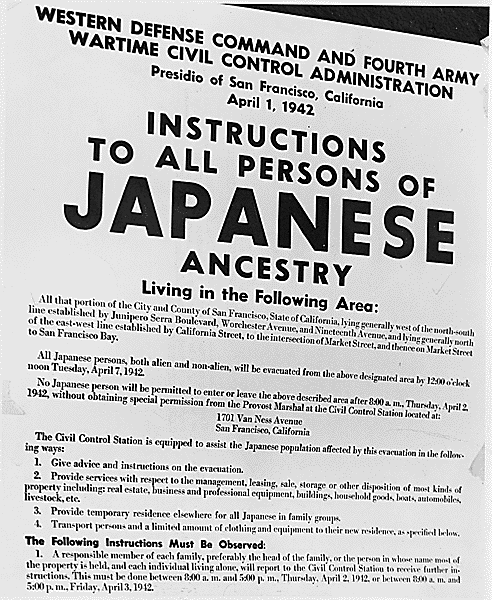
Marissa: The response was swift and devastating. Executive Order 9066 issued by President Roosevelt authorized the forced removal of Japanese Americans from the West Coast to internment camps in the interior U.S., no matter if they were citizens of the United States or not. Japanese families were forced to sell businesses and homes at a fraction of their worth, often given just days to dispose of generations of accumulated property. They were then transported to hastily constructed internment camps in desolate inland areas, where they would spend years behind barbed wire, their constitutional rights suspended in the name of national security. This was not met with significant resistance from Los Angeles’s non-Japanese population. Instead, many saw it as a necessary wartime measure.
Elizabeth: Between San Diego and Los Angeles, military installations multiplied rapidly, transforming small coastal areas into bustling bases. Each weekend, the city’s entertainment districts swelled with up to 50,000 servicemen on leave. These young men, many away from home for the first time, flooded into downtown dance halls, bars, and theaters, creating a volatile mix with the local population. Many white soldiers were from rural areas and were unaccustomed to the racial mixing more common in an urban environment. Los Angeles streets became places where civilians crossed paths with uniformed soldiers and sailors seeking entertainment.
Marissa: The wartime transformation of Los Angeles exposed and intensified deep-seated racial prejudices that had long simmered beneath the city’s surface. In the midst of wartime anxieties and racial tensions, the jazz scene in Los Angeles was in full swing. Los Angeles was a jazz hub from the 1920s to the 1950s, with the city’s African American Central Avenue corridor as the center of the jazz scene, with many clubs and dance halls popular among the city’s youth. As mainstream radio waves carried the sanitized sounds of the Hit Parade, jazz venues offered an environment full of music that was everything conventional society feared: sensual, spontaneous, and impossible to control.
Elizabeth: On stage, black and white musicians played together, and the audience consisted of young people of different races moving to the same rhythms. In these smoky clubs and crowded dance halls, the strict social hierarchies of daytime Los Angeles had the potential to disappear. The zoot suit emerged as the visual embodiment of this cultural defiance.
Marissa: Zoot suits were a style of menswear with an exaggerated silhouette. These suits were wide at the padded shoulders. The high-waisted pants ballooned in the middle and tapered dramatically at the ankles. Zoot suit wearers often accessorized with long chains that swung with each step, thick leather-soled shoes, and porkpie hats. The way these “zoot suiters” carried themselves became as distinctive as their clothing. They developed a characteristic stride – part strut, part glide – that radiated confidence and self-possession. Young women who adopted the style paired their suits with short and full skirts or pencil skirts and carefully styled hair, creating their own version of this defiant style. The zoot suit became a declaration of identity and a celebration of Black and Brown youth culture.
Elizabeth: The style itself had emerged from African American urban communities, where it represented more than mere fashion – it was a powerful statement of cultural pride and self-determination. As the look spread through Los Angeles’s diverse neighborhoods, it found particularly enthusiastic adoption among Mexican American, Italian American, and Filipino youth. This cross-cultural embrace of African American style signaled a significant shift in urban culture, as young people from different ethnic backgrounds found common ground in their appreciation for this bold fashion statement.
Marissa: While the zoot suit transcended racial boundaries, it was Los Angeles’s Mexican American youth who found themselves most closely associated with – and ultimately targeted for – wearing these distinctive garments. Despite their status as American citizens, many born in the United States, young Mexican American men and women faced increasing scrutiny and harassment from local authorities who viewed their fashion choices as signs of delinquency.
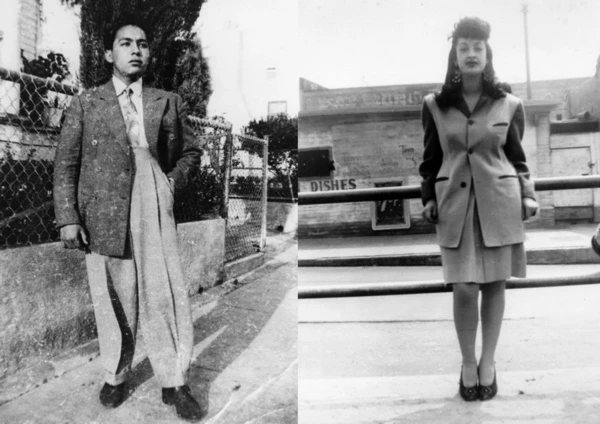
Elizabeth: The attack on Pearl Harbor and America’s entry into World War II brought sweeping changes to every aspect of civilian life. As the nation mobilized for total war, the government began implementing strict rationing policies that touched every sector of the economy. In March 1942, the War Production Board turned its attention to clothing manufacture.
Marissa: The new regulations mandated a dramatic reduction in fabric use – 26% across the board. Esquire magazine dubbed the resulting minimalist designs “streamlined suits by Uncle Sam.”[1] These new guidelines effectively outlawed the manufacture of zoot suits, whose silhouette and generous proportions required significantly more material than standard menswear. Women’s fashion faced similar restrictions, with full skirts and dresses becoming more streamlined.
Elizabeth: Most established tailoring businesses fell in line with the new requirements and stopped producing any garments that violated War Production Board guidelines. However, that did not stop the demand for zoot suits and an underground economy centered in Los Angeles and New York City developed to supply the coveted suits. A network of bootleg tailors emerged, working to satisfy the continued desire for these now-controversial garments. Young people who already owned zoot suits continued to wear them proudly, maintaining their distinctive style despite growing criticism.

Marissa: This defiance of wartime rationing regulations struck a particularly raw nerve with servicemen and many white civilians. The zoot suit, which had begun as a fashion statement was increasingly interpreted as an unpatriotic act. In these white Angelenos’ eyes, every yard of excess fabric used in a zoot suit represented material diverted from the war effort and the sight of young men strutting down the street in voluminous suits while soldiers wore standardized uniforms became a source of growing resentment and added a veneer of patriotic justification to existing racial prejudices.
Elizabeth: Many Mexican American youth self-identified as pachucos and pachucas, Mexican-American youth in the 1940s who rebelled against mainstream American culture through their style, music, and language. Historian Catherine Ramirez describes pachuquismo as style- highlighting clothes like the zoot suit but also hair, pompadours for men and women and stark makeup for women- but also highlights language and speech as ways that pachucos set themselves apart from older Mexican society and white American society. Not unlike the hep talk or jive that young African Americans adopted during the same period, as described in The Autobiography of Malcolm X. In the early 1940s, authorities’ obsession with Mexican American youth culture extended beyond their distinctive fashion and hairstyles to encompass their unique way of speaking. Law enforcement officials, newspaper reporters, and academics became increasingly fixated on pachuco slang, treating this vibrant form of linguistic expression as yet another sign of supposed delinquency. Just as the zoot suit challenged mainstream fashion norms, pachuco dialect – a creative blend of English, Spanish, and street vernacular – represented a form of cultural resistance that authorities found threatening.

Marissa: On the outskirts of Los Angeles, in what would later become the city of Bell, was a reservoir known as the Sleepy Lagoon, where Mexican American youth found refuge. In an era when racial segregation barred them from many of the city’s public swimming pools and recreation facilities, this irrigation reservoir on the Williams ranch became an unofficial gathering spot for young people seeking escape from the summer heat and the watchful eyes of authority. During daylight hours, teenagers splashed in its cooling waters, while after dark the secluded spot transformed into a hang-out spot for young couples.
Elizabeth: On August 1, 1942 several couples from the 38th Street neighborhood made their way to this familiar spot. Among them were Hank Leyvas and his girlfriend Dora Barrios. Leyvas was one of the older youths from the 38th Street neighborhood who was popular and whom many of the younger boys looked up to.
Marissa: The night turned violent when a group of young men from a rival neighborhood launched an attack upon Leyvas and Barrios, who suffered a vicious beating. Hank Leyvas returned to his home turf on 38th Street to gather allies for a revenge attack. The attack on his girlfriend had crossed a line and the youths, both young men and women, were ready to retaliate. Within hours, nearly thirty young people crowded into vehicles and set out for the Sleepy Lagoon.
Elizabeth: Meanwhile, at another corner of the Williams ranch, a very different gathering was taking place. José Díaz, a young man who was born in Mexico but had grown up in America, was celebrating at a friend’s birthday party. The night held special significance for Diaz as he was soon to report for his induction into the U.S. Army.
Marissa: Finding no trace of his assailants at Sleepy Lagoon, Leyvas and the 38th street kids heard the party drifting from the other side of the Williams ranch. In their heightened state of anger and anticipation, the 38th street group was convinced that Leyvas and Barrios’ attackers had joined the party they could hear.
Elizabeth: The peaceful fiesta erupted into chaos as the two groups collided. A bout of grandstanding and fighting took place before the combatants dispersed into the night. The scene appeared to be like any other aftermath of a teenage rumble. But as neighbors ventured out to investigate the disturbance, they made a grim discovery. In the shadows lay José Díaz, beaten and stabbed. He was taken to Los Angeles General Hospital and died later that night.
Marissa: News of Diaz’s death became a catalyst for broader political action, as Governor Cuthbert L. Olson seized upon the incident to address what he perceived as a growing crisis of juvenile delinquency. His response unleashed a massive dragnet operation by the Los Angeles Police Department that swept through Mexican American neighborhoods, arresting more than 600 Mexican American teens. Law enforcement particularly targeted those who wore the zoot suit or pachuco style. From this sweeping wave of arrests, Hank Leyvas and twenty-two others were ultimately charged with Díaz’s murder.
Elizabeth: In 1991, Lorena Encinas, gave her version of the story to her son, Ted Encinas. According to her account, she had been among the guests at the Williams ranch birthday party on the night of August 1, 1942. The celebration was disrupted when her brother Louis and his friends attempted to crash the gathering. After a brief confrontation, the family demanded the boys leave. Later, Louis reportedly confided in Lorena that he and his friends had attacked a young man who had just left the party. When police arrived to investigate reports of a murder near the property, Lorena refused to provide any information about the fight, not wanting to incriminate her brother. She, along with other young women from the 38th Street neighborhood-Frances Silva, Josephine and Juanita Gonzales, and Dora Barrios- were taken into custody in the police’s initial sweep.[2]

Marissa: The timing of these arrests wasn’t coincidental. Throughout the spring and early summer of 1942, local newspapers had been stoking public fears with sensationalized coverage of “Mexican juvenile delinquency.” This media campaign had successfully pressured city officials to acknowledge what they characterized as an “awful situation” requiring immediate attention. The Sleepy Lagoon case provided the perfect opportunity for authorities to demonstrate their tough stance on the perceived threat.
Elizabeth: The resulting trial was named People v. Zammora but became popularly known as the “Sleepy Lagoon” trial. Initially, many of Los Angeles’s major newspapers gave the case only cursory attention. However, the Evening Herald and Express took a different approach, seizing upon the evocative “Sleepy Lagoon” name to craft a narrative that portrayed the accused as dangerous criminals. Their favorite phrase – “Goons of Sleepy Lagoon” – transformed routine coverage of grand jury proceedings into sensationalized entertainment. Other newspapers followed suit. This heightened media attention placed enormous pressure on Judge Charles Williams Fricke, who found himself presiding over what had become one of the most scrutinized trials in the city’s history.
Marissa: Lorena Encinas and the other women in custody were called to testify in the trial. Encinas refused to speak at the trial and was thrown into the Ventura School for Girls for her silence, without the benefit of a jury or trial. She remained imprisoned there for 11 months until she was released when she turned 21 years old.
Elizabeth: Judge Fricke was the presiding judge and like most of his fellow jurists in California, belonged to the city’s white elite – a group increasingly troubled by the growing visibility and assertiveness of the Mexican American community. Their concerns echoed through the pages of local newspapers, which painted lurid portraits of Mexican American youth as dangerous outsiders.
Marissa: Judge Fricke’s handling of the courtroom arrangements revealed how these prejudices could be embedded in legal procedure. Citing the logistical challenges of managing so many defendants, he ordered them seated in two alphabetical rows opposite the jury, physically separated from their attorneys who were confined to the defense table. This arrangement, which Fricke defended as necessary for maintaining order, effectively severed the access between the accused and their legal representation.
Elizabeth: Judge Fricke ruled that attorney-client communications during proceedings constituted “disruptions” and only allowed the defense lawyers opportunities to consult with their clients during breaks. Furthermore, the prosecution deliberately weaponized the young men’s appearance, insisting on referring to them as a gang while pointing to their zoot suit style and hairstyles as evidence of criminal character.
Marissa: In a particularly cruel strategy, the prosecution orchestrated with court officers to deny the defendants basic grooming and clothing changes, denying them haircuts or clean clothes. As weeks passed, their unkempt hair grew longer and their clothing became increasingly soiled. When defense attorneys protested this deliberate degradation of their clients’ appearance, Fricke dismissed their objections. He declared that their disheveled state offered crucial insight into their character, conveniently ignoring that this appearance was engineered by the prosecution’s own restrictions.
Elizabeth: As the trial dragged on, Fricke’s growing impatience with the defence was evident. His particular target became George Shibley, a defense attorney who had joined the case after its start. Shibley’s vigorous defense of his clients through frequent objections drew Fricke’s ire. Fricke made a habit of openly belittling both Shibley and the accused in front of the jury, which undermined their credibility in the eyes of the jurors. Apparently, the presumption of innocence was a privilege reserved for others, not these young Mexican American defendants.
Marissa: The verdict in the Sleepy Lagoon trial was decided in the newspapers well before the jury reached its decision in January 1943. When the sentences were finally handed down, their severity shocked even those who had expected harsh punishment. Five of the 22 indicted were able to have separate trials funded by their families and were acquitted: Joe Carpio, Richard Gastelum, Edward Grandpre, Ruben Pena, and Daniel Verdugo. Five were found guilty of assault and sentenced to six months to one year in jail, road camp, or the county farm: Andrew Acosta, Eugene Carpio, Victor Segobia, Benny Alvarez, and Joe Valenzuela. Nine young men were found guilty of second degree murder and sentenced to five years to life in San Quentin: Ysmael Parra, Manuel Reyes, Victor Thompson, Henry Ynostroza, Gus Zamora, Manuel Delgado, John Matuz, Jack Melendez, and Angel Padilla. And three were found guilty of first degree murder and sentenced to life imprisonment in San Quentin, one of California’s most notorious prisons: Henry Leyvas, Jose “Chepe” Ruiz, and Robert Telles.
Elizabeth: The trial served as the backdrop to daily interactions playing out on the streets of wartime Los Angeles as escalating tension between servicemen and civilians, particularly in the city’s ethnic neighborhoods, often ended in physical altercations. Military personnel on leave flooded into the city by the thousands, viewing it as their personal playground for drinking, womanizing, and brawling. While many residents accepted this intrusion as part of the war effort, others – especially in minority enclaves – refused to submit to the entitled behavior of many white servicemen.
Marissa: A dangerous cycle of provocation and retaliation emerged in the city’s ethnic neighborhoods. Young Black and Mexican American civilians, tired of some white military men’s disrespect, began targeting drunk sailors heading back to their bases, robbing them in what became known as “rolling” – attacks. The sailors, in turn, hurled racial insults as they passed through Black and Mexican neighborhoods. Whispers spread of white sailors prowling for Mexican American girls, while military bases buzzed with tales of violent retribution against white servicemen who dared to date across racial lines. The situation was further inflamed by sailors’ complaints about Mexican American youth directing sexual taunts at their wives and girlfriends.
Elizabeth: The traditional tensions between civilians and military personnel, common in any garrison town, became magnified through the lens of racial prejudice and cultural conflict. In Los Angeles’s segregated neighborhoods, what might have been simple friction between locals and visitors transformed into a powder keg of ethnic resentment, and mutual distrust.
Marissa: In May 1943, violence erupted at Venice Beach’s popular Aragon Ballroom. The incident began with complaints from white high school students who resented the growing presence of zoot suiters along the beachfront. The situation escalated when soldiers arrived at the ballroom spreading word that a sailor had been stabbed. A massive crowd, estimated at 500 people and consisting of both sailors and civilian whites, gathered outside the ballroom. As Mexican American dancers began leaving the venue, they found themselves walking into an ambush. The mob descended upon them, targeting any young person who appeared to be Mexican American, regardless of how they were dressed or their connection to any alleged incident.
Elizabeth: The violence raged until two in the morning. When the police finally intervened, they took the Mexican American youth into custody claiming it was “for their own protection.” This rationalization of selective arrest would become a familiar pattern in the months to come, as law enforcement consistently arrested Mexican Americans while letting white servicemen and civilians go. The Venice Riot served as a prelude to larger confrontations brewing in Los Angeles.
Marissa: The evening of Memorial Day 1943 set the stage for confrontation. As nightfall settled over downtown, about a dozen white servicemen – a mix of sailors and soldiers – spotted a group of young Mexican American women across the street. They decided to change course and approach the women.

Elizabeth: However, standing between the military men and the women was a group of young men wearing zoot suits. The encounter might have remained just another moment of street tension, but Sailor Joe Dacy Coleman grabbed one of the zoot-suited men by the arm, setting off a violent chain of events.
Marissa: Before Coleman could react, a blow from behind knocked him unconscious. The scene exploded into chaos as other Mexican youths joined the fray, attacking the servicemen with rocks, bottles, and fists. The sailors managed to retreat, carrying the unconscious Coleman back to the Naval Armory.
Elizabeth: As Coleman recovered from his injuries, his fellow sailors began organizing for revenge. Two days later, on the night of Thursday, June 3, the beginning of what would become known as the Zoot Suit Riots commenced. And it’s important to note here that “riots” is a misleading term for what was essentially a series of organized attacks against ethnic minorities.
Marissa: Approximately fifty white sailors marched out of the Naval Armory that evening, armed with improvised weapons. Their first target was Alpine Street, a neighborhood that had seen numerous clashes between white servicemen and young Mexican American civilians. Finding no zoot suiters there, the mob of sailors moved toward downtown, their frustration and anger building with each empty street. When they reached the Carmen Theater, they found their first victims – though not the hardened gangsters they claimed to be hunting.
Elizabeth: The sailors forced the theater to turn on its house lights, then methodically searched the aisles for their targets. The victims they found were twelve and thirteen-year-old boys who had simply gone to see a movie. As other moviegoers watched and protested helplessly, the mob of sailors stripped and beat the boys in front of the entire theater then threw their zoot suits into a makeshift fire.
Marissa: That same night eleven sailors disembarked from a bus onto Main Street in downtown. Their encounter with a group of young Mexican Americans in zoot suits quickly devolved into conflict. The white sailors claimed they were victims of an unprovoked gang attack, while the Mexican American youth maintained the servicemen had initiated the violence. The Los Angeles Police Department’s “Vengeance Squad” arrived at the scene with the explicit intention of ridding Main Street from what they characterized as the “loathsome influence of pachuco gangs.”[3]
Elizabeth: June 4th, the second night of violence, marked a dramatic escalation, both in scale and intent. As darkness fell, young Mexican Americans made bold displays of defiance, cruising past the Naval Armory and shouting challenges at the guards. This act of resistance, however, would soon be met with an overwhelming response that would transform isolated street fights into an assault on an entire community.
Marissa: The sailors’ retaliation was carefully orchestrated. About 200 servicemen commandeered a fleet of roughly 20 taxicabs. Rather than limiting their attacks to downtown areas or entertainment districts, they pushed into the heart of Mexican American Los Angeles – the neighborhoods of East Los Angeles and Boyle Heights. No longer were these simply retaliatory strikes against perceived antagonists; they had evolved into a broad attack on the Mexican American community itself. The sailors’ taxi convoy swept through the barrio, storming into any establishment that might harbor their targets – bars, cafes, and theaters all fell victim to their raids.
Elizabeth:The attacks took on a ritual quality as the sailors stripped their victims of their zoot suits, targeting anyone wearing the distinctive style regardless of their connection to any previous conflicts. The Los Angeles Police Department’s response to the escalating violence revealed a disturbing alignment with the attackers. Rather than fulfilling their duty to protect all citizens, officers openly admitted to a “hands-off” policy during the riots. One officer’s post-riot justification was particularly telling – he claimed that because many police were veterans of World War I, they wouldn’t “pick on kids in the service.”[4] This of course ignores the fact that Mexican Americans were overrepresented in the armed forces commiserate with their numbers in the larger population.

Marissa: As media coverage of the attacks spread, it attracted more people to join the violence and the riots took on a momentum of their own, expanding beyond their original targeting of zoot suiters to encompass anyone who appeared to be of Mexican heritage. On June 5th a group of adult Mexican American musicians, none wearing zoot suits, were attacked as they left the Aztec Recording Company after a recording session.
Elizabeth: The scale of the violence was captured in military commander Clarence Flogg’s stark report describing “hundreds of servicemen prowling downtown Los Angeles” in search of Mexican Americans to attack.[5] The Navy’s own documentation painted a disturbing picture of roving gangs of servicemen, armed with makeshift weapons including clubs, belts, knives, and tire irons. These groups, ranging from ten to 150 men, operated with tactical awareness, scattering whenever Shore Patrol approached.
Marissa: California journalist and civil rights advocate Carey McWilliams was a witness to the violence and wrote:
Marching through the streets of downtown Los Angeles, a mob of several thousand soldiers, sailors, and civilians, proceeded to beat up every zoot suiter they could find. Pushing its way into the important motion picture theaters, the mob ordered the management to turn on the house lights and then ran up and down the aisles dragging Mexicans out of their seats. Streetcars were halted while Mexicans, and some Filipinos and Negroes, were jerked from their seats, pushed into the streets and beaten with a sadistic frenzy.[6]
Elizabeth: In the midst of escalating violence, members of Los Angeles’s Mexican American professional class mobilized to seek official intervention. On June 5th, Attorney Manuel Ruíz led a delegation of Mexican American community leaders in meetings with city officials, attempting to use their position and influence to protect their community. Carey McWilliams reached out directly to California Attorney General Robert Kenny, pressing for Governor Earl Warren to launch an official investigation into the violence.
Marissa: The urgency of their appeals was underscored by events of June 6th, as the riots pushed deeper into East Los Angeles, bringing terror to the heart of the Mexican American community, forcing state officials to finally acknowledge the gravity of the situation.
Elizabeth: Attorney General Kenny’s meeting with McWilliams proved productive, resulting in the creation of the McGucken Committee. Auxiliary Bishop Joseph T. McGucken of Los Angeles was chosen to chair the investigation, reflecting an attempt to lend moral authority to the proceedings. The committee’s formation marked the first official recognition that the violence required formal investigation and response.
Marissa: The violence reached its height on Monday, June 7, as the riots transformed from targeted attacks into a massive display of racial violence. The local press became complicit in the attacks, with one Los Angeles newspaper brazenly publishing instructions for “de-zooting” victims – a step-by-step guide to public humiliation that called for stripping and destroying their clothing.

Elizabeth: That night, downtown Los Angeles became the gathering point for an enormous mob of 5,000 people. The violence had now attracted participants far beyond the original group of white sailors from the Armory. Military personnel – soldiers, Marines, and sailors – traveled from bases as distant as Las Vegas and San Diego to join in the attacks. Local taxi drivers became willing accomplices, offering free rides to both servicemen and civilians heading to riot areas.
Marissa: The white mob’s division into two groups revealed the broadening scope of racial violence. One section headed south toward Watts, the city’s predominantly African American district, while another pushed east into Mexican American neighborhoods. This split exposed how the riots had evolved from targeted attacks on zoot suiters into an opportunity for wholesale racial violence against minority communities.
Elizabeth: The riots finally began to subside on June 8th. Senior military officials, recognizing the severity of the situation, took the dramatic step of declaring all of Los Angeles off-limits to military personnel. The Shore Patrol, previously passive in the face of servicemen’s violence, finally received orders to arrest servicemen involved in the disorders.
Marissa: In a revealing response to the violence, the Los Angeles City Council chose to punish the victims rather than the perpetrators. They passed a resolution criminalizing the wearing of zoot suits, making the distinctive style punishable by thirty days in jail.
Elizabeth: Sporadic confrontations continued through June 9th, but the intensity had diminished significantly. However, the aftermath revealed deep divisions in how city leaders interpreted the events. The McGucken Committee, after careful investigation, identified racism as the fundamental cause of the riots – a conclusion that pointed to deep-seated social problems requiring serious attention and reform.
Marissa: Mayor Fletcher Bowron, however, offered a starkly different interpretation that revealed the depth of official denial. He laid blame on juvenile delinquents and white Southerners, explicitly rejecting any role of racial prejudice in the violence.
Elizabeth: A week after the riots subsided, First Lady Eleanor Roosevelt addressed the violent events in Los Angeles through her newspaper column. Breaking from the superficial explanations offered by local officials, she stated that the riots represented deep-seated racial prejudice, particularly against Mexican Americans, in the United States.
Marissa: The Los Angeles Times’ reaction to Roosevelt’s commentary is telling. The paper attacked the First Lady, accusing her of having communist sympathies and inflaming racial tensions – a common tactic used to discredit those who spoke out against racial injustice. (Sounds familiar to anti- diversity, equity, and inclusion (DEI) diatribes doesn’t it?)
Elizabeth: The investigation by the State Un-American Activities Committee under Senator Jack Tenney took an even more bizarre tactic. Tenney’s committee arrived in Los Angeles on June 21, ostensibly to investigate whether the riots were orchestrated by Nazi agents attempting to drive a wedge between the United States and Latin American countries. Despite Tenney’s claims of possessing evidence of “Axis-sponsored” involvement, no such proof ever materialized.[7]
Marissa: Japanese propaganda broadcasts seized upon the violence, using the racist violence of white servicemen against Mexican Americans to challenge America’s moral authority and expose the contradiction between its fight against fascism abroad and its treatment of minorities at home.
Elizabeth: A few months later on appeal, the Sleepy Lagoon case entered a new phase in November as defense attorney Ben Margolis Jr. mounted a massive legal challenge. His 508-page appeal brief to the Second District Court of Appeals, documented the numerous procedural irregularities and constitutional violations that had characterized the original trial. The sheer volume of the brief reflected both the complexity of the case and the magnitude of judicial misconduct that had marred the proceedings.
Marissa: Supporters of the defendants recognized the need for a more focused and permanent organizational structure to sustain their advocacy efforts. On November 4, the Citizens’ Committee for the Defense of Mexican American Youth, organized by labor activist LaRue McCormick, underwent a strategic transformation, emerging as the newly christened Sleepy Lagoon Defense Committee. This reorganization brought two powerful advocates into leadership positions: Carey McWilliams, the previously mentioned journalist and civil rights advocate, assumed the role of national chair, and Alice Greenfield McGrath stepped in as executive secretary. McGrath forged close friendships with many of the youths jailed at San Quentin, visiting them often and keeping them and the public abreast of the appeal process.
Elizabeth: The appeal process for the Sleepy Lagoon case reached its crucial moment on May 15, 1944, when Margolis presented his oral arguments before the Second District Court of Appeals. Meanwhile, the Sleepy Lagoon Defense Committee launched an innovative fundraising campaign, publishing Guy Endore’s The Sleepy Lagoon Mystery. The book sold over 25,000 copies in just three months.
Marissa: Manny Delgado was the first defendant released on parole and immediately joined the staff of the Sleepy Lagoon Defense Committee, working to help free his fellow defendants. On October 2, the Second District Court of Appeals overturned all of the Sleepy Lagoon verdicts. Judge Clement Nye subsequently dismissed the case entirely, leading to the release of Hank Leyvas and his co-defendants with their records cleared. The appeals court’s decision hinged on Judge Fricke’s egregious conduct during the original trial, particularly his ruling that prevented defendants from consulting with their attorneys during proceedings – a clear violation of their constitutional rights.

Marissa: While the defendants regained their freedom and cleared their names, the case was never reopened for a proper investigation. The shadow of uncertainty remained – the defendants’ innocence was never fully established in court, and the true killer of José Díaz was never identified or brought to justice.
Elizabeth: Judge Fricke’s handling of the Sleepy Lagoon trial, despite its eventual overturning and clear evidence of judicial misconduct, did nothing to diminish his professional standing or career trajectory. He continued to win reelection to the bench for more than two decades after the trial, serving until shortly before his death in 1958. Furthermore his textbooks on criminal law, which he continued to author and update throughout his career, became standard texts in California’s law schools. These works remained in use even after his death, shaping new generations of legal professionals long after the Sleepy Lagoon case.
Marissa: Eight decades after the events of 1943 the city of Los Angeles officially acknowledged its role in the Zoot Suit Riots. On June 9, 2023, the Los Angeles City Council finally issued a public condemnation of the riots and apologized for the city’s contribution to the violence.
Bibliography:
Alvarez, Luis A. The Power of the Zoot: Race, Community, and Resistance in American Youth Culture, 1940–1945. (Austin: University of Texas, 2010).
Escobedo, Elizbeth R, “The Pachuca Panic: Sexual and Cultural Battlegrounds in World War II Los Angeles,” Western Historical Quarterly, Vol. 38, No. 2 (Summer, 2007), 133-156.
Mazón, Mauricio. The Zoot-Suit Riots:The Psychology of Symbolic Annihilation. (Austin: University of Texas Press, 2010).
Pagán, Eduardo Obregón. Murder at the Sleepy Lagoon: Zoot Suits, Race, and Riot in Wartime L.A. (Chapel Hill: The University of North Carolina Press, 2004).
Peiss, Kathy. Zoot Suit: The Enigmatic Career of an Extreme Style. (University of Pennsylvania Press, 2011)
Ramírez, Catherine S. The Woman in the Zoot Suit. Durham, North Carolina: Duke University Press, 2010.
Notes
[1] O. E. Schoeffler and William Gale, Esquire’s Encyclopedia of 20th Century Men’s Fashions, (New York City: McGraw-Hill, 1973), 24.
[2] Eduardo Obregón Pagán, Murder at the Sleepy Lagoon: Zoot Suits, Race, and Riot in Wartime L.A. (Chapel Hill: The University of North Carolina Press, 2004), 224.
[3] Luis A.Alvarez, The Power of the Zoot: Race, Community, and Resistance in American Youth Culture, 1940–1945 (Austin: University of Texas, 201) 204.
[4] People & Events: The Zoot Suit Riots of 1943, PBS American Experience.
[5] Mauricio Mazón, The Zoot-Suit Riots:The Psychology of Symbolic Annihilation (Austin: University of Texas Press, 2010), 73.
[6] Carey McWilliams, North from Mexico: The Spanish-speaking People of the United States (Santa Barbara, California: Greenwood Press,1990), 243.
[7] “Nazis Spur Zoot Riots,” Los Angeles Daily News, June 9, 1943.

Discover more from DIG
Subscribe to get the latest posts sent to your email.

0 Comments